
Most class projects end with a grade. For two UCF graduate students, theirs ended up in a published scientific study. Their late-night telescope work helped show that a large asteroid in our solar system may have a shape never seen before.
The Students Behind the Project
Daejhanae Smith and Rhiannon Hicks are planetary sciences doctoral students in UCF’s Physics Ph.D. program. As part of an Advanced Observational Astronomy course, they designed and carried out their own research project.
They picked asteroid 44 Nysa, a large, bright asteroid in the main belt between Mars and Jupiter, because it was in a good position to observe in February.
A Long Night at the Telescope
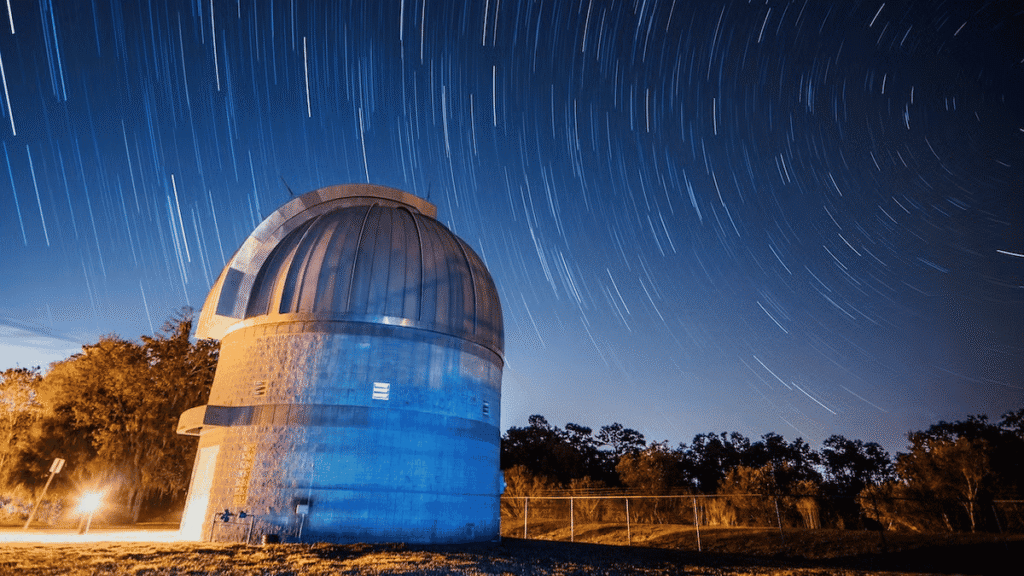
Using the telescope at UCF’s Robinson Observatory, the students observed the asteroid for about eight hours on the night of Feb. 22. They took more than 800 images, each with a 30-second exposure.
Because faraway asteroids can look just like stars, they used a special finder chart to make sure they were tracking the right object.
What They Found
From their images, the students built a light curve, which shows how an asteroid’s brightness changes as it spins. Their results showed two uneven brightness peaks and two uneven dips with each rotation, matching earlier observations going back to 1913.
Researchers then combined the students’ data with high-resolution observations to build a 3D model of the asteroid. The model suggests 44 Nysa may have three distinct lobes. If that’s confirmed, it could be the first known asteroid with this kind of shape.
Published Research
The findings appear in a study titled “Unmasking (44) Nysa: Evidence for a Trilobate Structure,” published in the August 2026 issue of the Journal of Astronomy & Astrophysics.
It’s a great reminder that real discoveries can start in the classroom, and that Central Florida students are helping answer big questions about space.